Recreating "Billie Jean" with Code: A Stress Test for the jdBasic Audio Engine
Introduction
I've been working hard on the audio subsystem for jdBasic, my custom C++ interpreter. To really test the capabilities of the synthesis engine and the sequencer, I decided to recreate one of the most iconic grooves in history: Michael Jackson's Billie Jean.
This wasn't just about making noise. It was about testing synchronization between cycle-based drum sequencers and linear melody players, managing polyphony, and synthesizing classic 80s sounds from scratch.
The Challenge: Synchronization
The biggest technical hurdle was syncing two different time domains in the C++ engine:
- The Drum Sequencer (
SOUND.SEQ): Runs on a strict 1-bar cycle (0.0 to 1.0 phase). - The Melody Player (
SOUND.NOTE): Plays linear "sheet music" that can span multiple bars.
Initial tests sounded chaotic - the chords would drift out of time with the drums. I had to update the C++ backend (SoundSystem.cpp) to expose the global sequencer phase to the interpreter.
Now, I can manually sync threads in jdBasic like this:
' Wait for the drum loop to restart (Phase close to 0.0)
DO : SLEEP 1 : LOOP UNTIL SOUND.GET_PHASE() < 0.90
The Sound Design
I didn't use any samples for the instruments (except the drums). Everything else is synthesized in real-time using the engine's oscillators and filters.
- Bassline: A Sawtooth wave with a low-pass filter at 500Hz and a bit of gain to simulate that punchy analog synth bass.
- Chords: A Sawtooth wave with a short release (0.4s) and heavy reverb to create the atmospheric background.
The Code (seq22.jdb)
Here is the core logic that runs the track. It uses the SQ module to handle the heavy lifting.
' --- 2-Bar Chord Loop ---
' [Chords] ~ ~ [Chords] ~ ~
C_BAR1$ = "[[f#3,a3,c#4] ~ ~ [g#3,b3,d#4] ~ ~ ~ ~]"
C_BAR2$ = "[[a3,c#4,e4] ~ ~ [g#3,b3,d#4] ~ ~ ~ ~]"

' --- The Arrangement ---
' Track 4 gets Chords
SOUND.NOTE "< " + C_BAR1$ + " " + C_BAR1$ + " >", TRUE, 4
The Result
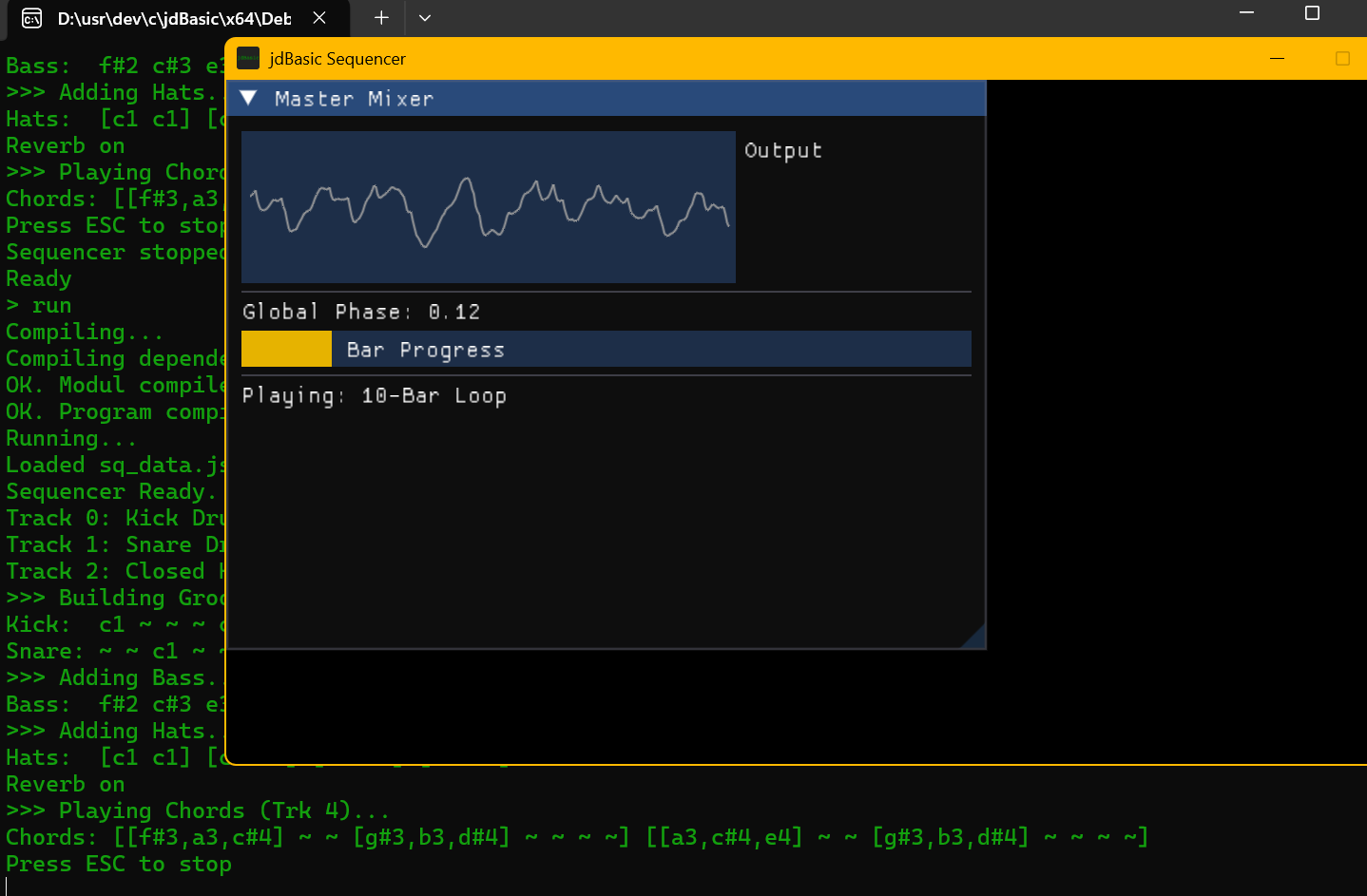
Here is the program running in real-time. You can see the oscilloscope visualizing the stereo mix as the script executes the arrangement.
Source Code
If you want to dig into the C++ engine or try running the script yourself:
- jdBasic Repository: github.com/AtomiJD/jdBasic
- Billie Jean Script: view on GitHub
What classic track should I try to code next? Let me know in the comments on YouTube!